
Chinese New Year (Spring Festival, 春节) is China’s biggest holiday and the longest production pause of the year. In 2027 it falls on Saturday, 6 February. For importers this means one simple thing: goods that have not left the factory by the end of January will most likely ship only in March.
China’s State Council usually publishes the official holiday schedule in November — we will add it to our holiday calendar as soon as it appears. But the real pause at factories is always longer than the official days off, so it is worth planning for it now.
Why the pause is longer than the official holiday
In recent years the official holiday has lasted 8–9 days. But most factory workers are migrants from other provinces, and they travel home for the festival, often thousands of kilometres away. As a result:
- 1–2 weeks before the holiday factories run with reduced staff, and some workshops close;
- in the same weeks trucks and warehouse space are hard to find — everyone is rushing to ship;
- after the holiday production restarts gradually, usually after the Lantern Festival (20 February in 2027), and factories often reach full capacity only in March;
- some workers do not return after the holiday, factories hire new staff — and the first batches after the break are more prone to defects.
In practice the real production pause lasts 3–4 weeks, and even longer for some product categories.
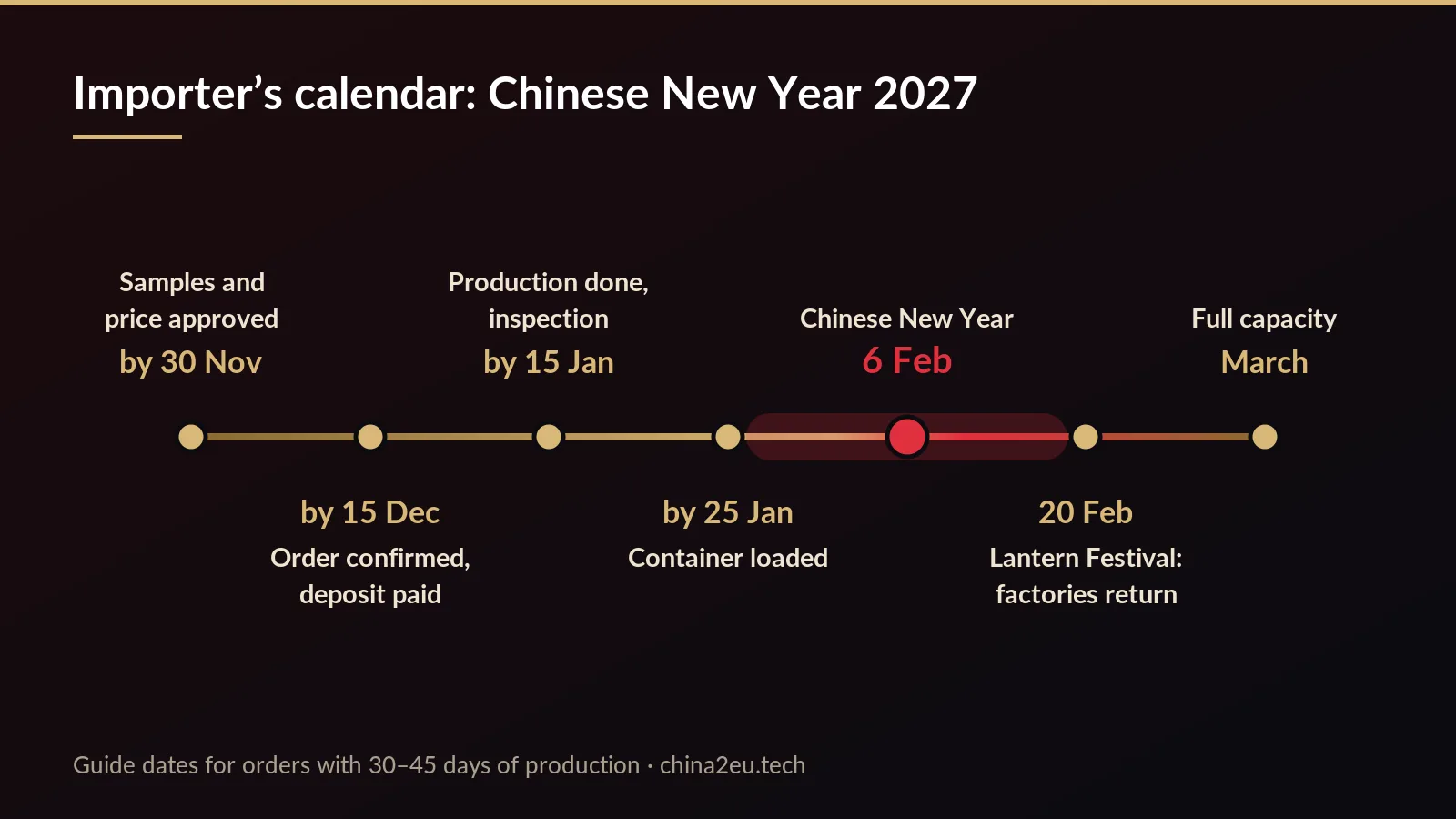
Importer’s calendar: key dates
- By 30 November. Approve samples, specifications and price. If samples are not yet approved, now is the last convenient moment.
- By 15 December. Confirm the order and pay the deposit. Factories are filling their pre-holiday capacity, and later orders are usually pushed to March.
- By mid-January. Finish production and carry out the pre-shipment inspection. After that there is no time left to fix defects.
- By 25 January. Load the container and get the goods out of the factory. Closer to the holiday, trucks and hands become ever scarcer.
- 6 February. Chinese New Year. The State Council will publish the official days off separately.
- 20 February. Lantern Festival. After it, factories gradually resume work.
- March. Production returns to full capacity. Those who booked a slot in the queue in advance get their goods first.
These are guide dates for a typical order with 30–45 days of production. For complex products — furniture, equipment, private-label goods — move all dates 2–4 weeks earlier. Exact shutdown dates must always be confirmed with each factory individually.
What happens to shipping
Before the holiday, demand for ocean freight from China traditionally rises as exporters rush to ship everything they have produced. Carriers are already adjusting rates — for example, Hapag-Lloyd raised Far East to Europe rates for shipments from 19 October 2026. So book space on the vessel 3–4 weeks before shipment and budget for a possible increase in freight costs.
In China: the problem is not just the vessel
Even if the container and the space on the vessel are booked early, that is no guarantee. Before the holiday the weakest link is the container trucks that move containers from the factory to the port. Drivers go home, and trucking companies not only raise prices sharply but simply refuse jobs — and a loaded container can get stuck at the factory while the vessel sails without it.
At destination: queues, costly trucking and demurrage
A few weeks later the whole pre-holiday wave of containers arrives at European ports almost at once. The consequences:
- Customs queues. Clearance takes longer, and containers wait for inspection and release.
- More expensive trucking from the port. Container trucks are now scarce at destination too, and delivery to your warehouse costs more.
- Demurrage and storage. If a container stays in port beyond the free period, the shipping line charges demurrage and the terminal charges storage — for every day of delay.
As a result, the final cost of the goods can end up well above the estimate made in October. Build a reserve for trucking and possible delays into the budget, agree a fixed rate for the haul to the port in advance, and prepare customs documents early so the container does not sit waiting in port. Early shipment pays off twice: the goods do not get stuck in China, and they arrive ahead of the main wave.
The most common mistakes before the holiday
- Late sample approval. Every week of delay with samples is a week you will miss at the end of January.
- Skipping inspection “to make it in time”. Right before the holiday factories are in the biggest hurry, and the risk of defects is highest.
- Paying the balance before inspection. The factory receives the balance before the container is loaded — but transfer it only after the inspection has confirmed the quality of the batch.
- Believing “we’ll make it”. A factory may promise anything, but the real pause starts earlier than the official holiday.
What to do if you are already late
- Split the order. Ship the part the factory can finish before the holiday, and the rest after.
- Look for ready stock. Some items can be found in warehouses — for example, at the Yiwu wholesale market.
- Book March production now. Orders confirmed before the holiday are the first to start after the break.
- Tighten control of the first post-holiday batch. New workers mean a higher risk of defects, so inspection is especially important here.
How we help
China2EU has been working in China for more than 12 years, with offices in Yiwu and Wenzhou. We check whether a factory can realistically finish before the holiday, monitor production, carry out pre-shipment inspections — and if the holiday deadline can no longer be met, we book a slot in the March queue.

We keep an up-to-date calendar of public holidays and days off in China for 2026–2027, including real factory downtime, on a separate page.