Ukraine’s construction sector is short of workers. According to the Confederation of Builders of Ukraine, the industry will need around 1.2 million workers by 2036 — twice the current workforce. At the same time, construction is becoming more expensive: according to the State Statistics Service of Ukraine, prices in the sector in September 2026 were 27.1% higher than a year earlier.
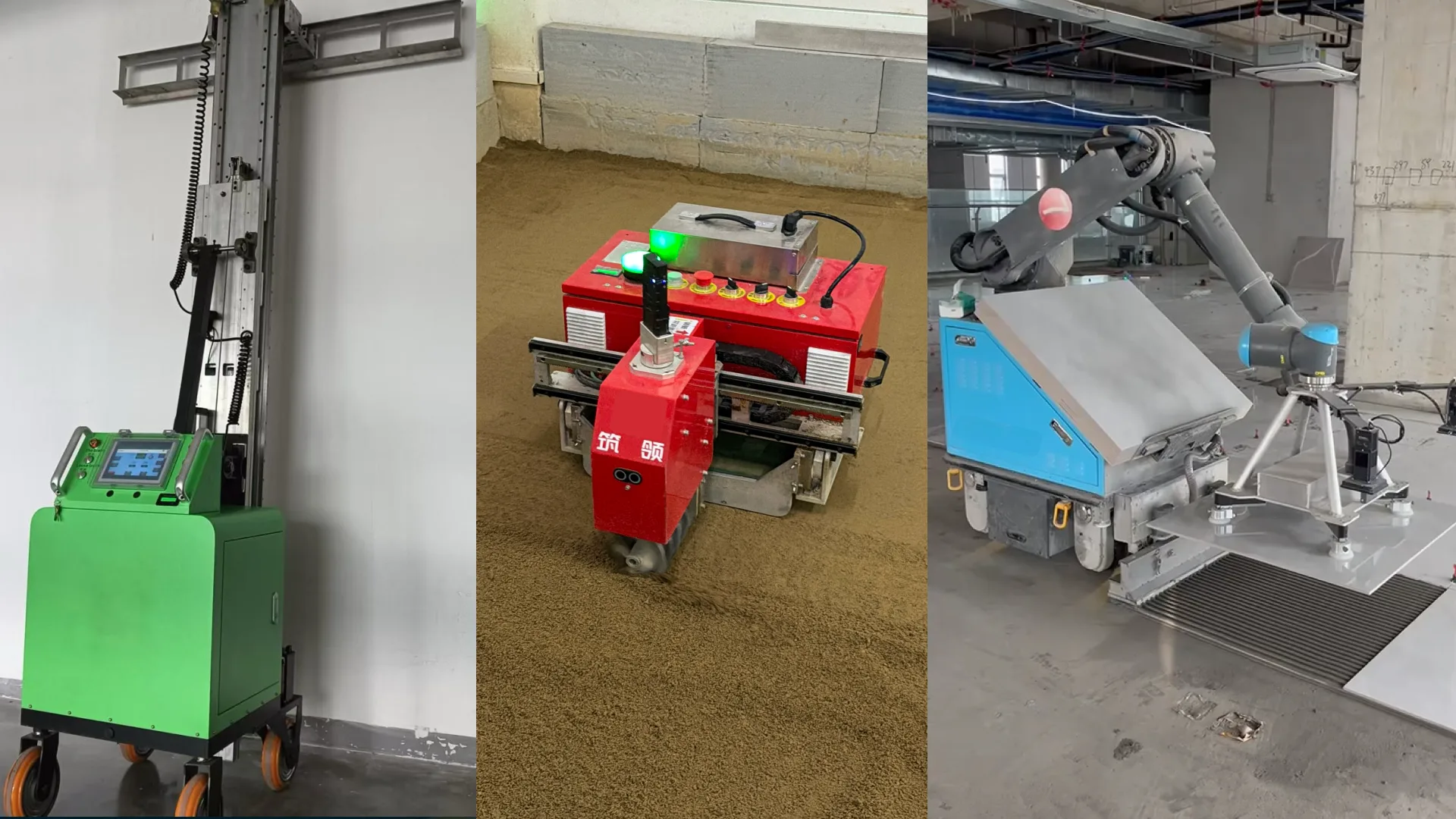
China is tackling the same problem — an ageing workforce and rising wages — with technology. Robots for screeding, plastering, skim coating and tile laying are no longer trade-show exhibits there: they work on residential developments, hospitals, schools and even a new airport terminal. Some of this equipment is already exported to Singapore, the UAE, the United States and European countries.
At China2EU, we studied catalogues, technical specifications and videos from real projects supplied by several Chinese manufacturers. In November 2026, we also visited a construction-robot factory in Nanjing in person, where we inspected equipment for a Ukrainian client. Below, we explain what these machines can do, how much work they complete in a shift, and what buyers in Ukraine or the EU should know before purchasing.
What Construction Robots Can Already Do
Floor Screeding
A floor-screeding robot works with a semi-dry sand-and-cement mix. A laser level is set up on site, and the robot levels the mix precisely to the laser plane: a receiver on the machine detects the beam and automatically adjusts the height. A person only needs to supply the mix and control the robot remotely.
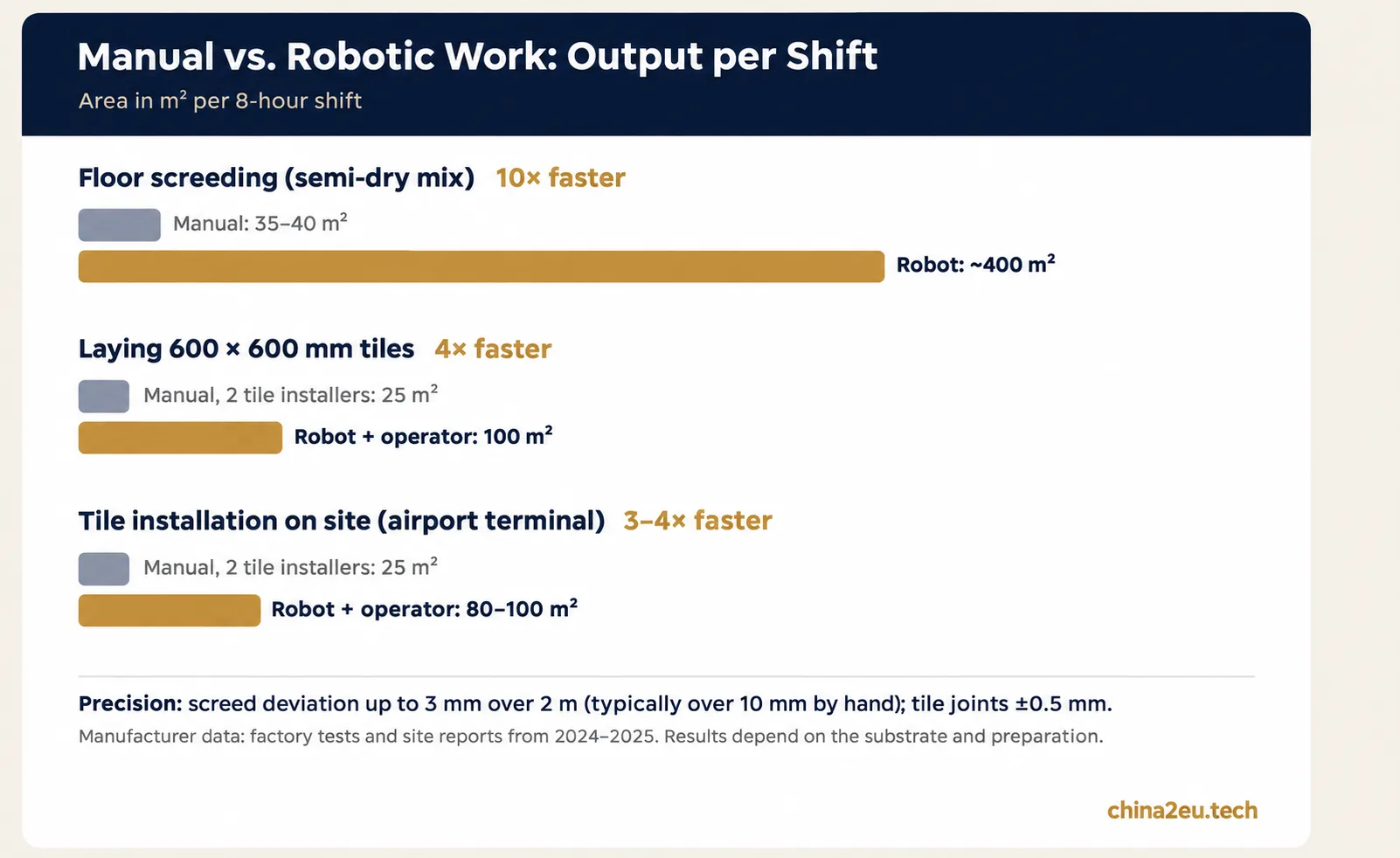
According to manufacturers, such a robot completes up to 55 m² per hour and more than 400 m² per day, compared with the usual 35–40 m² per day by hand. The deviation from level is no more than 3 mm over 2 m; with manual levelling it often exceeds 10 mm.
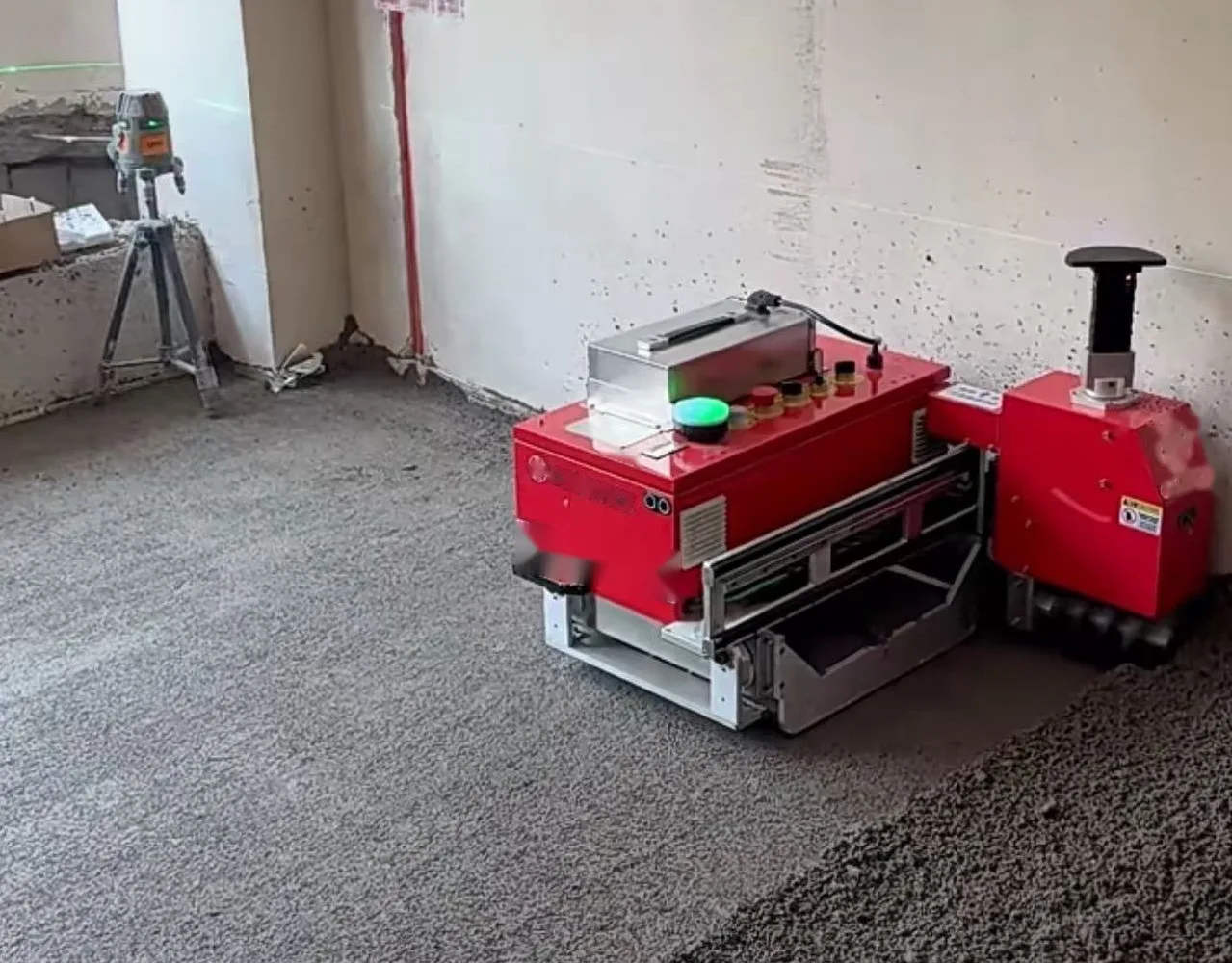
The process itself brings another advantage. Semi-dry screed is far less prone to cracking and dries much faster than wet screed, so tiles, laminate or parquet can be installed sooner. For large-format porcelain stoneware, marble and timber flooring, a level base is the key condition for a high-quality result.
Our Experience: Inspecting a Construction-Robot Factory in Nanjing
In November 2026, a client from Ukraine contacted China2EU looking for a construction robot to level floor screed before tile installation. Before moving ahead with the purchase, we decided to inspect the manufacturer in person and see the equipment at work.
Our team — two Ukrainian managers and a Chinese colleague — travelled to Nanjing, where the construction-robot factory is located.
During the visit, we toured the production facility, reviewed the equipment assembly process and spoke with the factory’s representatives. The practical demonstration was the most important part: we were shown the machine’s complete operating cycle — how it crosses an area and levels the screed mix.
For us, it was important not simply to read technical specifications in a catalogue, but to see the robot in action and assess how well the solution matched the client’s task.
That is why we always emphasise that, before purchasing complex equipment from China, buyers should verify not only the documents and stated output, but also the manufacturer itself and the machine’s performance in practice.
Wall Plastering and Skim Coating
A plastering robot is a trolley with a vertical mast. A mortar pump feeds material onto the wall, while the robot moves a wide screed rule from bottom to top and levels the coat across the full wall height in a single pass. The operator moves the machine to the next section instead of handling a rule all day.
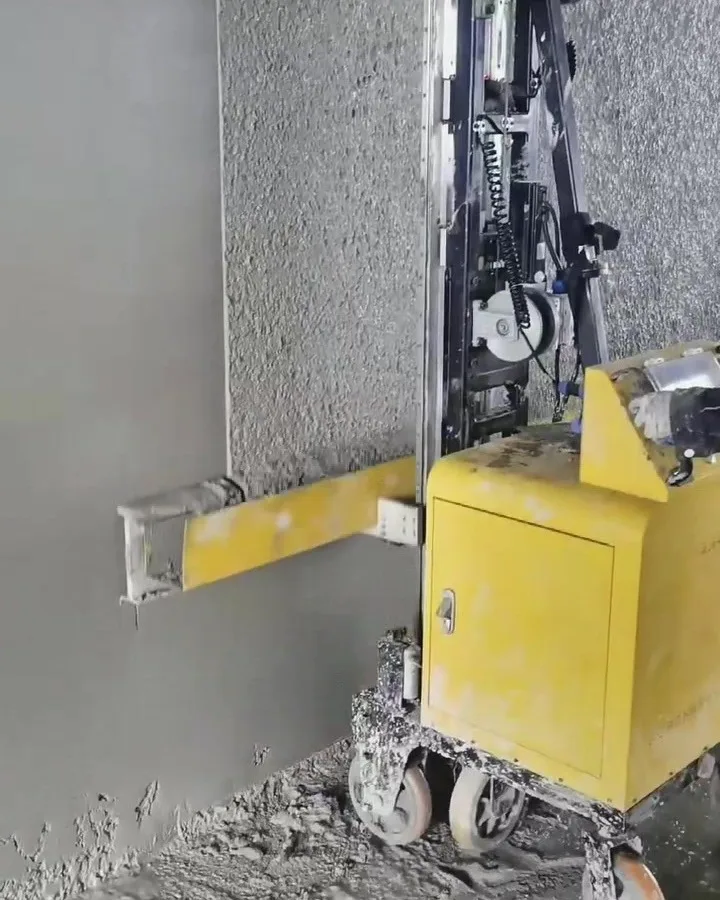
The next level is finishing robots: they apply skim coat, sand and paint walls at heights of up to 4.5–6 m. According to the manufacturer, skim-coating output is 60–100 m² per hour and painting output is 150–300 m² per hour. The manufacturer estimates labour-cost savings of 60% or more on these operations, and some models already have CE certification.
Tile Laying
The most sophisticated robot on this list lays tiles. It mixes and applies the adhesive, picks up tiles with suction cups, measures the joint with a camera, aligns each tile to the laser plane and presses it into place. It handles formats from 600×600 to 800×800 mm, while some models can work with tiles up to 750×1500 mm.
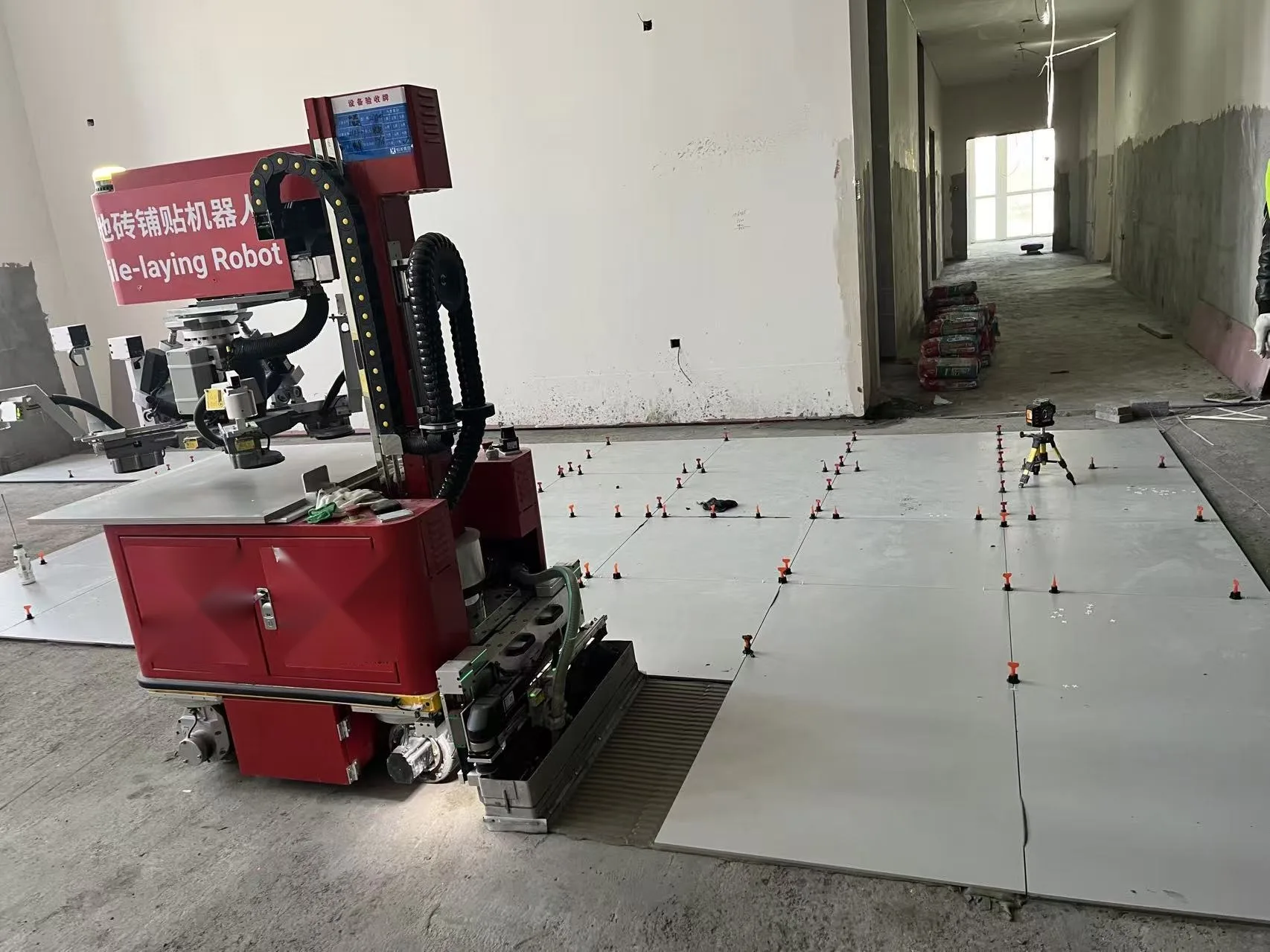
According to the manufacturer’s calculations, the robot lays around 100 m² in 8 hours, while two tilers complete about 25 m². Joint width is maintained to ±0.5 mm, and the adhesive is spread evenly, leaving almost no voids beneath the tiles.
The figures are supported by real projects. At the new terminal of Guangzhou Airport, a robot laid around 8,000 m² of 600×600 mm tiles, completing 80–100 m² per shift. Quality was checked against standard tolerances: flatness within 2 mm over 2 m and a maximum 0.5 mm lippage between adjacent tiles. These robots have also worked on projects in the UAE and in a residential building in New York, where local workers operated them after training.
Floor Setting-Out
Another useful assistant is a setting-out robot. It transfers drawings from CAD or BIM directly onto concrete: grid lines, wall and column outlines, and door and window openings. Accuracy is ±2–3 mm and, according to the manufacturer, it works 4–6 times faster than a crew of 4–6 people. Setting-out errors that later lead to costly rework are virtually eliminated.
The Numbers at a Glance
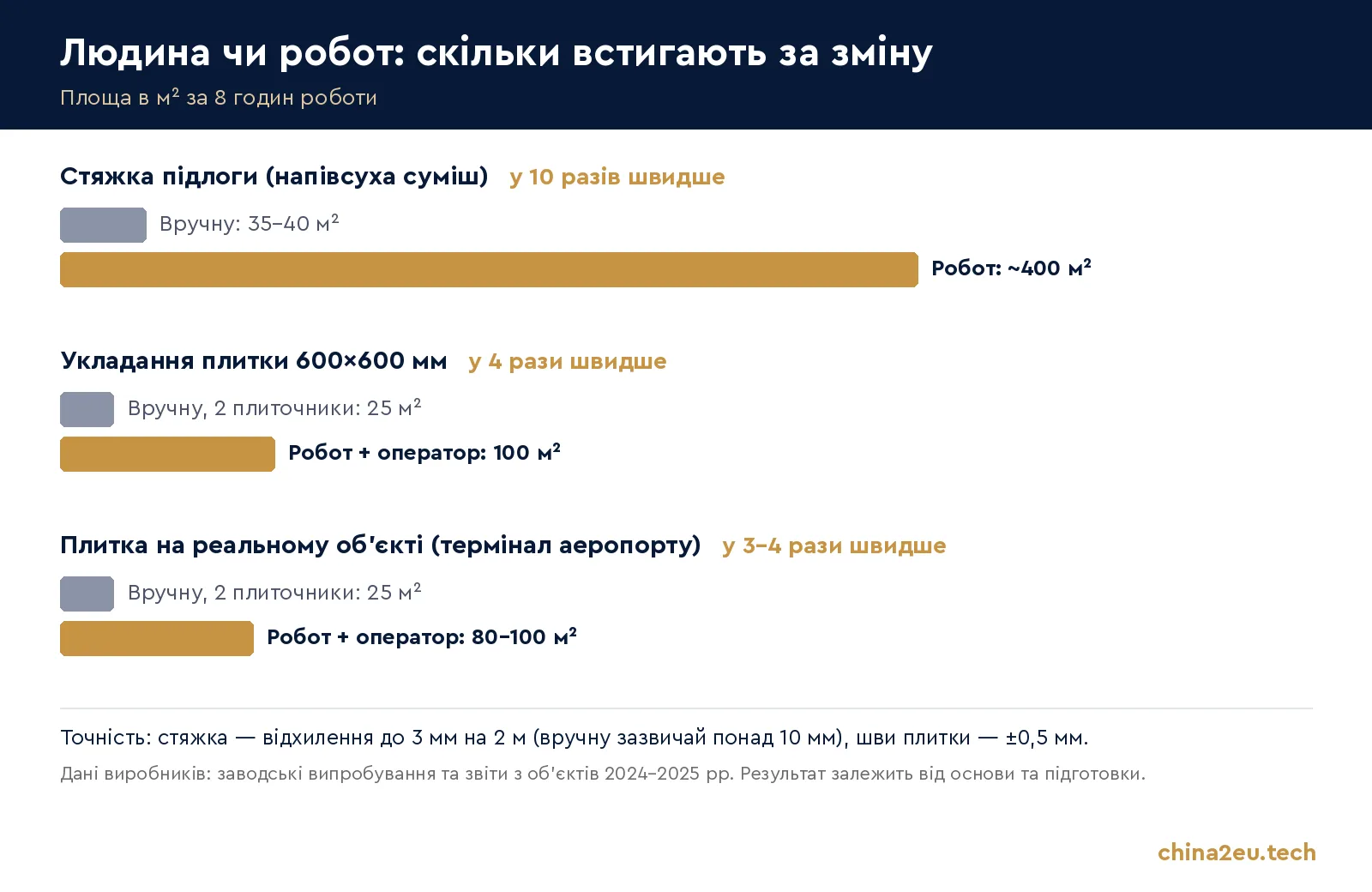
The main benefit is not speed alone. A robot does not tire toward the end of a shift, rush on a Friday evening, or lay the hundredth square metre differently from the first. Quality no longer depends on which skilled worker happens to be available.
Why Quality Is Not Worse — and Is Often Better
- Consistency. The robot repeats the same operation with the same parameters, so the result does not depend on a person’s experience or fatigue.
- Laser-guided accuracy. Screed and tile heights are set by a laser plane rather than by eye.
- Fewer hidden defects. Evenly applied adhesive leaves minimal voids beneath tiles, while semi-dry screed is far less prone to cracking.
- Measurable results. Many machines store data on area, speed and equipment operation, which can also be reviewed remotely.
- Safety and health. A person no longer spends hours kneeling or standing on scaffolding — the machine takes over work at height and in strenuous positions.
Where People Are Still Essential
Robots do not replace the entire crew — they change its composition. Instead of several tradespeople, an operator and an assistant work on the area. However, buyers should understand several limitations in advance:
- Area. Robots are most cost-effective on large, level areas such as corridors, lobbies, offices and apartments with standard layouts. A tile-laying robot makes sense in rooms of 30 m² or more.
- Substrate preparation. For a tile-laying robot, the floor must already be level, with a deviation of no more than 5 mm over 2 m.
- Corners and complex areas. On real projects, robots cover 85–90% of the area; cuts, corners and non-standard sections are completed by a person.
- Training and service. The operator needs training, while spare parts and technical support must be available — these points should be agreed before purchase.
- Payback. Manufacturers of tile-laying robots quote a payback period of 9–10 months at consistent utilisation. For your business, it should be calculated using your own workload and rates.
How to Import a Construction Robot from China with China2EU
We do not sell a “pig in a poke”. Before you invest, we help verify the equipment in operation:
- We select manufacturers and models for your task: screeding, plastering, finishing, tile laying or setting-out.
- We arrange a demonstration at the factory or on a project in China — in person or by video call.
- We check the configuration, supply voltage, availability of EU certificates and English-language documentation.
- We agree operator training, warranty terms and a stock of spare parts.
- We oversee dispatch and delivery to your site.